Tar
______________________________________________________________________
The tar
The most widely used plucked stringed instrument today is the tar. Although its name is
old,the instrument itself appears to be relatively new. The tar is not mentioned by any
of the medieval writers,neither is it portrayad in the miniatures of the sixteenth
canturies. Furthermore it is conspicuosly absent from the chief iconographic source of
the safavid period,the wall paintings of musicians on the palace of Chehel Sottun.
persian theorists usually date the appearance of the tar with the Qajar period.
(late 18 to 19 centturies),when it begins to be depicted in miniatures and photographs.
The origin of this uniquely shaped,double-bellied instrument has not yet been
established. Its unusual form and possible relation to the Euopean guitar-which has a
more refined version of the same general shape and a relation in name-awaken
one'sinterest. Two hypotheses seem applicable here.. One is that the tar evolvved
sometime during the 17 and 18 centuries from other instrument. Its long neckand
system of frets resemble the settar an instrument with a long history. The settar,
however does not possess either of the distinctive. features of the tar,the skine
membrance or the double belly. These two characteristics are found in another old
instrument,The gaycheck , which,however,has a short neck and is bowed. A second
hypothesis is that it came directly from the tabriz,where a similar instrument may be
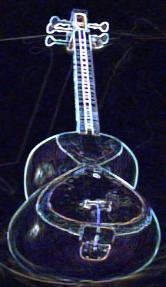
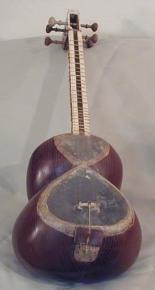
found. The double-bellied body of the tar is made of mulberry wood carved in two
sections, cutting the body in half from front to back. These sections are joined by a
vertical around the back and bottom of the instrument. The long neck is also glued to
the body. A standard tar is 95cm to 105 ,in length 25 to 30 cm, across the widest part
and 20 cm. deep witha neck 60cm. it is a heavy instrumnet and in order to support it on
the knee,some players use a small footrest that raises the leg to a comfortable position.
The face of the tar is a sheepskine membrane in two separate sections, the lower one
about one and half times larger than the upper. The bridge supporting the strings is
attached directly to the lower membrance. The sex strings of the tar are made of
metal,five of steel and one ,the lowest of brass. They are tuned in pairs,usually cc,gg
,cc. According to Khalgi, the tar had only 5 strings this century,when the musician
Darvish khan added the c beside the lowest c. The above tuning is standard for the
instrument, but other special tunings are customarily used for different dastgah-ha.
Famous player:
1- Darvish Khan
2- Alinagi Vaziri
3- Hossien Gholi
4- Mirza Abdollah
5- Aliakbar shanazi
6- Mahamd reza lotfi
7- Hossien allizadeh
8- Daryosh talai
9- Farhang sharif
10- Hoshang zarif
11- Jalil shanaz
The tar
The most widely used plucked stringed instrument today is the tar. Although its name is
old,the instrument itself appears to be relatively new. The tar is not mentioned by any
of the medieval writers,neither is it portrayad in the miniatures of the sixteenth
canturies. Furthermore it is conspicuosly absent from the chief iconographic source of
the safavid period,the wall paintings of musicians on the palace of Chehel Sottun.
persian theorists usually date the appearance of the tar with the Qajar period.
(late 18 to 19 centturies),when it begins to be depicted in miniatures and photographs.
The origin of this uniquely shaped,double-bellied instrument has not yet been
established. Its unusual form and possible relation to the Euopean guitar-which has a
more refined version of the same general shape and a relation in name-awaken
one'sinterest. Two hypotheses seem applicable here.. One is that the tar evolvved
sometime during the 17 and 18 centuries from other instrument. Its long neckand
system of frets resemble the settar an instrument with a long history. The settar,
however does not possess either of the distinctive. features of the tar,the skine
membrance or the double belly. These two characteristics are found in another old
instrument,The gaycheck , which,however,has a short neck and is bowed. A second
hypothesis is that it came directly from the tabriz,where a similar instrument may be
found. The double-bellied body of the tar is made of mulberry wood carved in two
sections, cutting the body in half from front to back. These sections are joined by a
vertical around the back and bottom of the instrument. The long neck is also glued to
the body. A standard tar is 95cm to 105 ,in length 25 to 30 cm, across the widest part
and 20 cm. deep witha neck 60cm. it is a heavy instrumnet and in order to support it on
the knee,some players use a small footrest that raises the leg to a comfortable position.
The face of the tar is a sheepskine membrane in two separate sections, the lower one
about one and half times larger than the upper. The bridge supporting the strings is
attached directly to the lower membrance. The sex strings of the tar are made of
metal,five of steel and one ,the lowest of brass. They are tuned in pairs,usually cc,gg
,cc. According to Khalgi, the tar had only 5 strings this century,when the musician
Darvish khan added the c beside the lowest c. The above tuning is standard for the
instrument, but other special tunings are customarily used for different dastgah-ha.
Famous player:
1- Darvish Khan
2- Alinagi Vaziri
3- Hossien Gholi
4- Mirza Abdollah
5- Aliakbar shanazi
6- Mahamd reza lotfi
7- Hossien allizadeh
8- Daryosh talai
9- Farhang sharif
10- Hoshang zarif
11- Jalil shanaz

theory of music
| TEL : 310-370-7073 |
| TEL : 310-370-7073 |