Santur
The Santur
This important instrumnet belong to the category of zithers. string instrumnet which
have no neck or yoke,whose strings are usually open,not stopped and whose
resonating body can be a board box,stick or tube. In the class of board are both
psalteries and dulcimers as well as the western keyboard instruments. The psaltery
usually has strings of gut,silk,or nylon and the strings are plucked. The dulcimer on
the other hand has metal strings that are struck with plectra. Both kinds of
zither,psalteries and dulcimers,are found . The other psaltery or plucked zither is
the qanun ,an instrument now rarely used. but still extremely important . The
dulcimer or santur on the ,on the other hand ,is extremely popular . The instrument
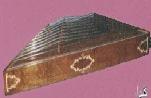
itself,however was not depicted until the 13 century .The struck zither ,the santur is
a shallow box in the from of a regular trapezoid. Inside the box are wooden props
and the top surface is pierced with two small rosettes. There are note there are
foure string of identical pitch and thus eighteen right ,are tightened by means of
metal pegs inserted directly supported by a small wooden bridige. The bridges of
the santur are cleverly arranged to produce the rather sizeable rang of three octaves
on the a fairly small playing surface. There are two sets of nine strings- one set of
brass,the other of steel-strung alterately from top to bottom. The notes of the
lowest octave,E to F, are played on the brass strings whosebridges are set along
pitch. The notes of the two higher octaves E to F and,,are played on the steel
strings whose bridges along the left side are placed so as to divide the string into
two sections,or short and medium lengths for the high and the middle ranges
respecttively. Thus ,each group of the steel strings and the adjacent brass strings
give three notes from left to right e and e. The note E can be played on the
extreme right of the brass strings,but this is not usual. There is only one group of
strings for each of the seven notes of the octave with the exepton of E and F . A
single note in any given register, there fore,can have only one value ,that is ,the
note G can be tuned to G-natural,G-flat,G-sharp or either of the microintervals
,G-koron or G-sori,but not to more than one of these at same time. If the player
reguires both a G-natural and a G-kroron in the same piece,he must sound one of
them in a different register.
The famous player
1- Abol hassan saba
2-faramarz payvar
3- Hossien saba
4- hossein malek
5- parviz mashkatian
6- Jalil andalibi
This important instrumnet belong to the category of zithers. string instrumnet which
have no neck or yoke,whose strings are usually open,not stopped and whose
resonating body can be a board box,stick or tube. In the class of board are both
psalteries and dulcimers as well as the western keyboard instruments. The psaltery
usually has strings of gut,silk,or nylon and the strings are plucked. The dulcimer on
the other hand has metal strings that are struck with plectra. Both kinds of
zither,psalteries and dulcimers,are found . The other psaltery or plucked zither is
the qanun ,an instrument now rarely used. but still extremely important . The
dulcimer or santur on the ,on the other hand ,is extremely popular . The instrument
itself,however was not depicted until the 13 century .The struck zither ,the santur is
a shallow box in the from of a regular trapezoid. Inside the box are wooden props
and the top surface is pierced with two small rosettes. There are note there are
foure string of identical pitch and thus eighteen right ,are tightened by means of
metal pegs inserted directly supported by a small wooden bridige. The bridges of
the santur are cleverly arranged to produce the rather sizeable rang of three octaves
on the a fairly small playing surface. There are two sets of nine strings- one set of
brass,the other of steel-strung alterately from top to bottom. The notes of the
lowest octave,E to F, are played on the brass strings whosebridges are set along
pitch. The notes of the two higher octaves E to F and,,are played on the steel
strings whose bridges along the left side are placed so as to divide the string into
two sections,or short and medium lengths for the high and the middle ranges
respecttively. Thus ,each group of the steel strings and the adjacent brass strings
give three notes from left to right e and e. The note E can be played on the
extreme right of the brass strings,but this is not usual. There is only one group of
strings for each of the seven notes of the octave with the exepton of E and F . A
single note in any given register, there fore,can have only one value ,that is ,the
note G can be tuned to G-natural,G-flat,G-sharp or either of the microintervals
,G-koron or G-sori,but not to more than one of these at same time. If the player
reguires both a G-natural and a G-kroron in the same piece,he must sound one of
them in a different register.
The famous player
1- Abol hassan saba
2-faramarz payvar
3- Hossien saba
4- hossein malek
5- parviz mashkatian
6- Jalil andalibi
Theory of music

| TEL: 310-3707-7073 |
| TEL: 310-37-7073 |