Nay
The Nay
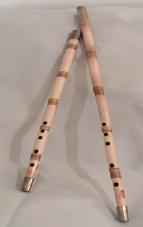
the simplest and perhaps the oldest instrument used for the performance is the nay.
This vertical flute can be traced back to prehistoric times in the Middle East. The
nay is made of a long piece of cane, often decorated with figures and wound in
several place with cord or plastic for decoration and for strength. Fifty to sixty
centimeters long, it often has a metal mouthpiece that is simply an extension of the
cane. Near the lower end are six finger holes on the front and generally one hole in
the back.
The player holds his instrument slanting downwards, blowing across the upper edge.
An unusual feature of the nay is two different mouth positions. To blow the tones of
the lower register, the player holds the instrument against one side of his nearly
closed lips. The notes of the upper register are produced by inserting the end of the
instrument between the two upper front teeth with the player’s upper lip entirely
covering the end of the mouthpiece. Because the construction of the nay is still so
simple-it is only a piece of cane or reed with holes bored into it-this instrument is
difficult to play well. A pure tone, without excessive
breathiness, is achieved only rarley, thus professional players are correspondingly
few. The nay is, of course, one of the most important folk instruments, typically
played by shepherds. In some of the provinces, a shorter transverse flute may be
used instead of the long vertical one. The nay holds a special place in the music of
the sufis. It is a symbol of the spirit that lifts mans soul to the divine principle.
The famous player
1- Nahib Esdolleh
2- Kassayi
3- Jamshid Andalibi
4- Hassan Nahid
5- Mossavai
the simplest and perhaps the oldest instrument used for the performance is the nay.
This vertical flute can be traced back to prehistoric times in the Middle East. The
nay is made of a long piece of cane, often decorated with figures and wound in
several place with cord or plastic for decoration and for strength. Fifty to sixty
centimeters long, it often has a metal mouthpiece that is simply an extension of the
cane. Near the lower end are six finger holes on the front and generally one hole in
the back.
The player holds his instrument slanting downwards, blowing across the upper edge.
An unusual feature of the nay is two different mouth positions. To blow the tones of
the lower register, the player holds the instrument against one side of his nearly
closed lips. The notes of the upper register are produced by inserting the end of the
instrument between the two upper front teeth with the player’s upper lip entirely
covering the end of the mouthpiece. Because the construction of the nay is still so
simple-it is only a piece of cane or reed with holes bored into it-this instrument is
difficult to play well. A pure tone, without excessive
breathiness, is achieved only rarley, thus professional players are correspondingly
few. The nay is, of course, one of the most important folk instruments, typically
played by shepherds. In some of the provinces, a shorter transverse flute may be
used instead of the long vertical one. The nay holds a special place in the music of
the sufis. It is a symbol of the spirit that lifts mans soul to the divine principle.
The famous player
1- Nahib Esdolleh
2- Kassayi
3- Jamshid Andalibi
4- Hassan Nahid
5- Mossavai
Theory of music


| Tel : 310-4971544 USA |
| Tel : 310-4971544 USA |