Chang
___________________________________________________________________________________________
The chang
The musical instrument most often depicted in art,both ancient and medieval,and also
the one most celebrated in kiterature is the chang. This harp is clearly represented in
theElamite relief of malamir,dating from the seventh century ,which portrays three
musicians:one is playing a triangular harp and one a cithara or lyre, the third
instrument,unfortunately,has deteriorated beyond recognition. Several boatloads of
harists arefound accompanying the boar hunters in the sassanian rock carving at Tag-i
Bustan. The chang became famous in literature. Two well known poets were also
noted harpists, Rudaki,who lived during therule of the samanids at the end of the ninth
century and beginning of the tenthand farukhi of the eleventh century. The harp
depicted in miniatures of the sixteeth and seventeenth centuries was a large triangular
instrument whose body must have been over a metter in lenght.
Accordingtoartists,representations,the player supported the lower frame on his knee
,and the body,curved at the upper end to form a scroll was often elaborately decorated.
The number of strings varied according to the artists,but usually approached thirty.
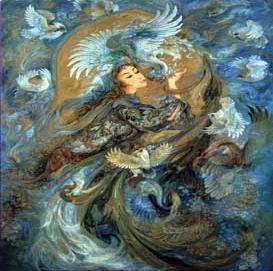
The chang is extinct as a musical instrument. but it does continue its importance as a
motive in the visual arts and is still found in contemporary paintings,metal work and
printed cloth.
The musical instrument most often depicted in art,both ancient and medieval,and also
the one most celebrated in kiterature is the chang. This harp is clearly represented in
theElamite relief of malamir,dating from the seventh century ,which portrays three
musicians:one is playing a triangular harp and one a cithara or lyre, the third
instrument,unfortunately,has deteriorated beyond recognition. Several boatloads of
harists arefound accompanying the boar hunters in the sassanian rock carving at Tag-i
Bustan. The chang became famous in literature. Two well known poets were also
noted harpists, Rudaki,who lived during therule of the samanids at the end of the ninth
century and beginning of the tenthand farukhi of the eleventh century. The harp
depicted in miniatures of the sixteeth and seventeenth centuries was a large triangular
instrument whose body must have been over a metter in lenght.
Accordingtoartists,representations,the player supported the lower frame on his knee
,and the body,curved at the upper end to form a scroll was often elaborately decorated.
The number of strings varied according to the artists,but usually approached thirty.
The chang is extinct as a musical instrument. but it does continue its importance as a
motive in the visual arts and is still found in contemporary paintings,metal work and
printed cloth.
Theory of music